Looking for land that feels under the radar but still sits in the path of growth? That is the appeal of Holland, Texas. If you want a quieter Central Texas location with usable acreage, varied tract sizes, and access to the I-35 corridor, Holland deserves a closer look. Let’s dive in.
Why Holland Stands Out
Holland describes itself as a rich blackland farm community in Bell County, located about ten miles east of Salado and midway between Austin and Waco. That gives you a very different feel from a high-profile suburban growth market. It is small-town and rural in character, but it is not isolated.
That distinction matters if you are thinking about land as a long-term play. Bell County reached an estimated population of 399,578 in July 2024, up 7.8% from the 2020 census. Bell CAD also notes that the county’s land base has been shifting from rural toward suburban and urban uses as growth continues.
Is Holland a Quiet Investment Play?
The short answer is yes, with an important caveat. Holland looks more like a quiet exurban land pocket than a fast-moving speculative market. You are not buying into a headline suburb with constant turnover, but you are buying inside a broader Central Texas corridor with real growth pressure.
That makes Holland appealing if your strategy is patient rather than short-term. The local story is less about fast flips and more about buying usable land, understanding the tract’s physical and utility profile, and holding for lifestyle use, agricultural use, future building, or eventual resale in a growing region.
What the Holland Land Market Looks Like
Current listing snapshots point to a thin but active market. Zillow shows 30 land listings in Holland, while LandWatch shows 36. LandSearch shows 116 properties near Holland, with an average listing age of 181 days, a median list price of $732,000, and an average list price of $1,316,379.
Those numbers suggest limited inventory and patient turnover. In other words, Holland does not appear to be a high-liquidity land market where listings vanish overnight. Buyers and sellers may have room for due diligence, but pricing still depends heavily on acreage size, frontage, utilities, and how ready the tract is for use.
Current Price Range Is Wide
One of the clearest signs of market variety is the spread in asking prices. Current examples range from a 6,599-square-foot town homesite at $47,500 to a 2.92-acre lot at $199,000, with 5-acre tracts around $199,900 to $250,000. Larger acreage also appears in the market, including 41.92 acres at $1.257 million and 347.01 acres at $5.03 million.
On a per-acre basis, that spread is even wider. Smaller lots with utility access can command much higher per-acre pricing than larger agricultural tracts. That means you should avoid judging Holland by one price point and instead compare parcels by use case, improvements, and location.
What Kinds of Land Are Common in Holland?
Holland offers more than one land product. The local mix includes small homesites, 2-to-15-acre ranchettes, and larger 40-plus-acre agricultural or mixed-use tracts. That variety gives buyers options, whether you want a simple build site, income-producing acreage, or a longer-term hold.
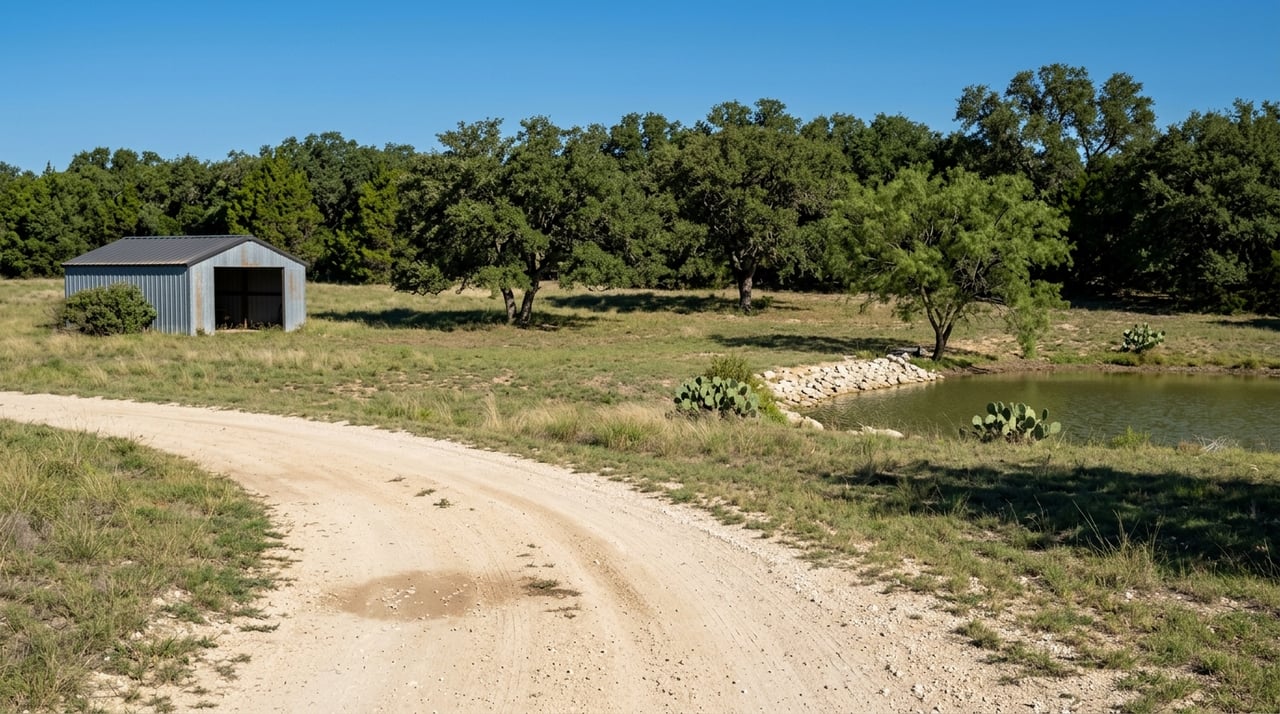
Many listings reference ag-exempt pasture, dryland cropland, coastal hay, cattle use, horse use, ponds or stock tanks, and road frontage. This is not just a market for one type of buyer. You can find land suited to lifestyle ownership, agricultural use, or future planning, depending on the tract.
Raw Land and Utility-Ready Tracts Both Exist
Another strength of Holland is that the inventory is not limited to raw acreage. Some current listings include water meters, power at the road, or access to city-style utilities. That can materially change both your timeline and your upfront planning.
Examples in current listings include a 15-acre parcel with a water co-op meter and stock pond, a 5.77-acre tract with a water meter and power at the road, and a 7.03-acre ag-exempt tract with a six-inch water main and fire hydrant. There is also a 2.92-acre lot in the rural subdivision of Honey Ridge just outside Holland.
For a buyer, this matters because utility access can be one of the biggest differences between a tract that is ready for action and one that will require more time, cost, and coordination. In a market like Holland, utility-ready land may justify a stronger price than raw acreage that still needs major diligence.
Location Is Part of the Investment Story
Holland’s access is a major part of its appeal. The city places itself midway between Austin and Waco and east of Salado off I-35. Current listings also regularly tie Holland to Temple, Georgetown, Killeen, and Austin.
That puts Holland in a useful middle ground. You get rural character and lower visibility than some better-known submarkets, but you are still connected to major employment, transportation, and growth nodes in Central Texas.
Distances Support Regional Access
Current listing examples help show what that looks like on the ground. One farm listing between Holland and Salado places the property about 9 miles from Salado and I-35, 20 miles from Temple, and 30 miles from Georgetown. Another 13.18-acre tract is described as 2 miles from Holland, 11 miles from Salado, 17 miles from Temple, 32 miles from Georgetown, 34 miles from Killeen, and 51 miles from Waco.
For many buyers, that is the sweet spot. You may be able to secure acreage in a quieter setting without losing practical access to the broader Austin-Waco axis.
Due Diligence Matters More Than Hype
Because Holland is a thinner land market, due diligence matters more than market buzz. Two tracts with similar acreage can have very different value if one has frontage, water access, utility availability, or agricultural use already in place. A lower asking price does not always mean better value.
This is where land buyers need to look beyond surface-level listing descriptions. The real questions are about access, utility capacity, holding costs, permitted use, and how much work the parcel will require before it fits your goals.
Check Utilities Early
If you are looking at an in-town parcel or homesite-style tract, municipal utility support may be part of the equation. The City of Holland has a water utilities department and publishes current water rates and policies. That gives buyers a local point of reference when evaluating service availability and cost.
If you are considering acreage outside town, listing language about water meters, co-op access, or power at the road becomes especially important. In Holland, utility status is one of the clearest lines between a tract that is mostly raw and one that may be closer to usable.
Agricultural Appraisal Can Affect Holding Costs
If you plan to hold land as working acreage, Bell CAD should be part of your research from the start. Bell CAD states that agricultural applications for the 2025 tax year are due no later than April 30. It also notes that land must be principally devoted to agricultural use to the degree of intensity generally accepted in the area.
Bell CAD may periodically request updated agricultural applications as well. For buyers considering pasture, hay ground, or livestock use, that makes agricultural appraisal more than a side detail. It can directly affect your holding-cost assumptions and should be reviewed early in the process.
Who Holland May Fit Best
Holland may be a strong fit if you want one of three things. First, it works for buyers who want a manageable homesite or ranchette with a quieter setting and regional access. Second, it may suit buyers looking for usable acreage with agricultural potential.
Third, it can appeal to investors who prefer to buy in a less crowded market inside a growing corridor. The broader Austin-Waco-Hill Country rural land market finished 4Q2025 at $7,911 per acre, up 8.15% year over year, while Texas statewide rural land averaged $5,214 per acre, up 6.56% year over year. Against that backdrop, Holland stands out less as a speculative hotspot and more as a measured location where tract quality and execution matter.
The Real Opportunity in Holland
The best case for Holland is not hype. It is position. You have a small rural town in Bell County, access to the I-35 corridor, a market with both raw and utility-fed parcels, and a county that is seeing land-use change as growth continues.
That combination can create opportunity for buyers who know what they are looking at. If you focus on tract usability, utility reality, access, and holding strategy, Holland can make sense as a quiet land investment play in Central Texas.
If you want help evaluating acreage, homesites, or a tract with longer-term development potential, Land Homes Texas can help you think through feasibility, land value, and what the property can realistically support.
FAQs
Is Holland, Texas mainly a raw land market?
- No. Holland has both raw acreage and parcels with features like water meters, power at the road, and subdivision-style homesites.
What tract sizes are common in Holland, Texas?
- Current listings suggest a mix of small homesites, 2-to-15-acre ranchettes, and larger agricultural or mixed-use tracts over 40 acres.
How close is Holland, Texas to the I-35 corridor?
- Holland is about ten miles east of Salado off I-35, and listings also connect it to Temple, Georgetown, Killeen, Austin, and Waco.
Does agricultural appraisal matter for Holland, Texas land buyers?
- Yes. Bell CAD says land must be principally devoted to agricultural use at an accepted local intensity level, and 2025 agricultural applications are due by April 30.
Is Holland, Texas a fast-moving land market?
- Current listing data suggests a thinner market with limited inventory and patient turnover rather than a high-liquidity market.