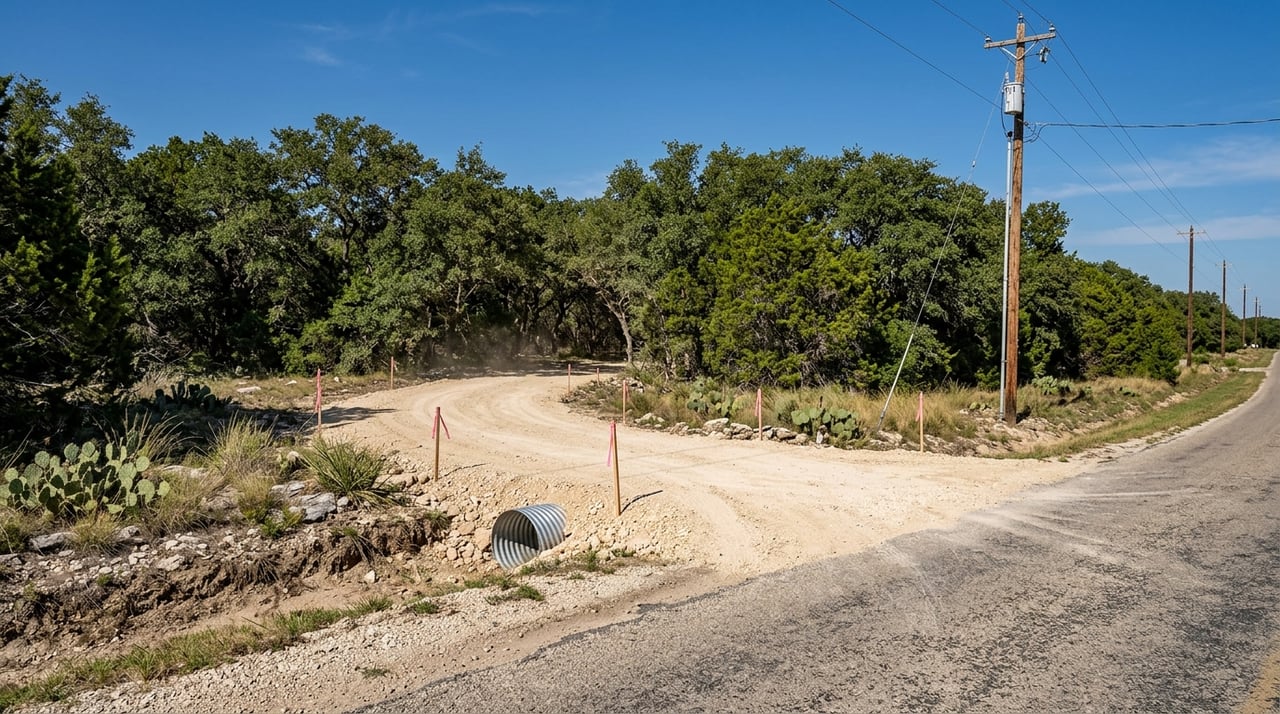
Are you looking at a 5-to-50-acre tract around Georgetown and wondering whether it can actually become lots, roads, and closings instead of just a promising sketch on paper? That is the right question to ask, especially in a market that has grown quickly and now demands tighter underwriting on frontage, utilities, and entitlement risk. If you are evaluating small tracts for development, you need a practical way to sort attractive dirt from buildable inventory. Let’s dive in.
Georgetown growth raises the stakes
Georgetown is not the same market it was a few years ago. The U.S. Census Bureau estimates Georgetown at 106,907 residents in 2025, up from 67,176 in the 2020 Census, and Williamson County reached an estimated 727,480 residents in 2024.
That growth matters because it supports ongoing interest in suburban and exurban housing product. Still, growth alone does not make a tract feasible. You still need to test jurisdiction, access, utilities, drainage, and entitlement path before you treat any acreage as development-ready.
Start with jurisdiction first
Before you model lot yield, identify where the tract sits from a regulatory standpoint. In the Georgetown area, that means checking whether the land is inside city limits, in Georgetown’s ETJ, or in unincorporated Williamson County.
That first step matters because Texas Local Government Code Chapter 212 requires a plat when land is divided into two or more parts for subdivision lots, streets, alleys, or other public-use areas inside city limits or where applicable in the ETJ. Chapter 242 also provides that an ETJ plat cannot be filed with the county clerk without approval from the entity authorized to regulate subdivision plats in that area.
In plain terms, your first underwriting question is not just acreage or lot count. It is who has platting authority and what approval path applies.
Use Georgetown GIS early
Georgetown gives you an unusually strong set of public GIS tools for early tract review. The city’s planning web map includes city limits, ETJ, future land use, zoning districts, PUDs, thoroughfare layers, airport zones, overlays, and parcel data.
The utility web map adds water service areas, wastewater boundaries, pressurized mains, gravity mains, reuse waterlines, hydrants, and subdivision and property layers. Georgetown also publishes open-data layers for city limits, ETJ, zoning, future land use, city-approved MUDs and PIDs, traffic impact fee service areas, and thoroughfare plan data.
For buyers, builders, and investors, this means you can pressure-test a tract very quickly. You can often identify major red flags before spending time on a full concept layout.
Check zoning and future land use
A physically attractive tract can still need major entitlement work. Georgetown’s UDC is the primary guide to development within the city and governs both zoning and subdivision applications.
The city also states that its UDC is being updated to align with the Comprehensive Plan and revise standards tied to zoning, subdivision, transportation, utilities, environmental quality, landscaping and trees, and development processes. That means your tract may need rezoning, a PUD, a thoroughfare adjustment, or a development agreement before it can move to platting.
This is why future land use and existing zoning should be reviewed before you get attached to a target lot count. If the entitlement path is longer than expected, your timeline and carrying costs may change fast.
Access can make or break the deal
Access is often the first hard physical constraint on a small tract. A property may have enough acreage on paper, but if frontage, road alignment, or internal circulation do not work, yield can fall apart.
Texas law allows municipalities to adopt reasonable street-construction and drainage specifications for subdivisions, and Georgetown’s planning maps include thoroughfare and street-network layers that help you evaluate frontage and alignment early. That gives you a practical way to compare what the tract offers today against what the city may require.
Recent Georgetown plat cases show access is not a theoretical issue. The Reserve at Berry Creek Section 1B, a 13.75-acre plat, required access variances for specific lots, and Woods of Fountainwood Phase 4, a 35.991-acre plat, required subdivision variances.
The lesson is simple: do not assume a small or mid-sized tract has an easy approval path just because it fronts a road. Frontage width, geometry, and the relationship to the thoroughfare plan all matter.
Utilities decide real feasibility
Utilities are the other major gating item, especially on smaller tracts where off-site costs can change the economics quickly. Georgetown’s utility map lets you review water service areas, wastewater boundaries, and nearby utility mains.
That is a useful first screen, but it is not the same as confirmed service. TCEQ explains that CCN and service-boundary tools identify who provides water or sewer service and notes that if a property is not in a service area or does not have service, the owner may need another water source.
For underwriting, the practical question is not whether water or sewer is somewhere nearby. It is whether service exists now, whether capacity is available, and whether extensions, district financing, or off-site improvements may be required.
A local Georgetown example shows why this matters. A 2.418-acre final plat for Woodlake Subdivision Phase 5 included a wastewater-capacity discussion, with staff specifically discussing whether the line would need upsizing.
That is a strong reminder that even a small tract can carry meaningful infrastructure risk. If wastewater or water capacity needs work, lot yield alone will not save the deal.
Floodplain and drainage affect net acreage
One of the most common mistakes in early underwriting is using gross acreage as if all of it can produce lots. In reality, drainage, detention, utility easements, buffers, rights-of-way, and floodplain can reduce what is actually developable.
Williamson County’s FEMA floodplain map service was updated on July 23, 2024, and Georgetown’s planning maps also include environmental layers tied to drainage and water quality. These are not minor overlays. They can materially change layout options and push a tract below your target yield.
The safest approach is to model from net developable acreage, not gross acreage. Subtract space for rights-of-way, detention, utility easements, buffers, and any floodplain before dividing by your intended lot size.
Geometry matters more than raw size
In Georgetown, local public records suggest entitlement risk on smaller tracts is often driven more by frontage, utilities, access, and site geometry than by acreage alone. That is an important point for anyone comparing multiple sites in the same budget range.
The public record examples span a wide range of tract sizes. Woodlake Subdivision Phase 5 at 2.418 acres involved wastewater-capacity analysis, The Reserve at Berry Creek Section 1B at 13.75 acres involved access and road-geometry variances, and Woods of Fountainwood Phase 4 at 35.991 acres involved subdivision variances.
Those examples support a practical conclusion for 5-to-50-acre evaluations around Georgetown. A cleaner-shaped tract with workable frontage and utility access may outperform a larger site with awkward geometry or infrastructure problems.
Thoroughfares can change the plan
For larger context, Georgetown also has recent cases where development moved beyond platting into plan-level changes. A 104.19-acre Simon/Wolf Ranch case involved a Century Plan amendment and a thoroughfare-plan shift.
Even if your tract is much smaller, this example is still useful. It shows that road alignment and land-use intensity can become central to feasibility, especially on the edges of the city or in areas where future transportation planning may affect access and layout.
If a tract relies on assumptions about future road connections or access points, verify those assumptions early. Small mistakes here can lead to large redesign costs later.
A practical pre-offer checklist
Before you make an offer or finalize pricing, walk through a disciplined tract screen:
- Identify whether the land is inside Georgetown city limits, in the ETJ, or in unincorporated Williamson County.
- Verify water and sewer service area, CCN coverage, and whether line extensions or district financing may be needed.
- Confirm frontage, access points, and the applicable thoroughfare plan before sketching lot count.
- Overlay floodplain and drainage constraints early to estimate net developable acreage.
- Check zoning, future land use, and whether rezoning, a PUD, or a development agreement appears likely.
- Review whether traffic impact fee service areas apply.
- Reserve street names early if the layout creates new roads, since Williamson County maintains an active and reserved street-name list.
This process will not answer every question, but it will help you avoid underwriting a tract on assumptions that do not survive public review.
How to think about small-tract underwriting
If you are evaluating small tracts around Georgetown for development, the smartest approach is conservative and sequential. Start with jurisdiction, then test access, utilities, drainage, and entitlement path before you spend time debating final product mix.
In many cases, the difference between a strong tract and a costly one is not visible from the road. It shows up in service boundaries, plat authority, frontage geometry, floodplain overlap, and whether the city’s maps and code support your intended plan.
That is where an integrated review can save time. When brokerage, feasibility, and development coordination work together, you can move from broad interest to a more lender-ready, decision-ready position with fewer surprises.
If you want help evaluating a Georgetown-area tract with a practical eye on feasibility, entitlement path, and marketability, request a review from Land Homes Texas.
FAQs
What is the first step when evaluating a Georgetown tract for development?
- The first step is confirming jurisdiction: whether the tract is inside Georgetown city limits, in the ETJ, or in unincorporated Williamson County, because that affects plat approval and development rules.
Why do utilities matter so much on small tracts around Georgetown?
- Utilities can determine whether a tract is feasible at all, since nearby lines do not always mean current service or available capacity, and extensions or off-site improvements can materially affect cost and timeline.
How should you estimate lot yield on a small Georgetown development tract?
- Start with net developable acreage, not gross acreage, by subtracting likely space for rights-of-way, detention, easements, buffers, and floodplain before applying your target lot size.
What Georgetown public tools help review a tract before making an offer?
- Georgetown’s public GIS resources can help you review city limits, ETJ, zoning, future land use, thoroughfares, water service areas, wastewater boundaries, and other key layers used in early tract screening.
Can a small tract in Georgetown still need variances or extra entitlement work?
- Yes, public Georgetown examples show that even tracts as small as 2.418 acres and 13.75 acres have involved issues such as wastewater-capacity analysis, access variances, road-geometry concerns, or other subdivision variances.